
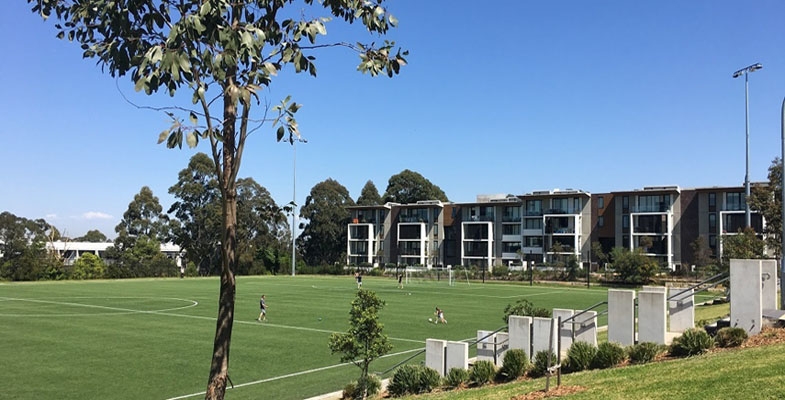
Why is Ku-ring-gai Council unable to accept that Charles Bean Oval is on the edge of Lane Cove National Park and is not an appropriate place for a synthetic playing field? The current synthetic surface was installed 13 years ago when the seriousness of the environmental and safety risks were not well understood. Now much more is known about the characteristics of synthetic turf and the foreseeable impacts of climate change.
Bushfire risk should be a paramount consideration
The risks from the field’s location as category 2 bushfire prone land are now recognised. In addition the location at the end of a narrow road would make evacuation very difficult. It is not only soccer players that will need to escape; there are also the residents of all the apartment buildings and school children.
Council’s very own draft Climate Change Policy also recognises the risks. The principles of the policy include these statements:
Reduce current and future risks to the community and the environment by avoiding development in high-risk hazard areas (particularly those expected to be at greater risk from climate change), and/or incorporate appropriate measures to reduce the risk to an appropriate level in accordance with relevant guidelines and statutory controls (including utilising appropriate land zoning).
Consideration of climate change impacts be mainstreamed and integrated throughout council decision making practices and frameworks, with appropriate mitigation and adaptation actions integrated into all strategic and operational management activities.
The NSW Chief Scientist and Engineer’s Independent Review into the Design, Use and Impacts of Synthetic Turf in Public Spaces contains this recommendation:
R1.4 Risk assessments are undertaken, and synthetic turf fields are not approved in areas of high environmental risk. This includes bushfire prone areas and areas with a higher likelihood of flooding. Assessments and testing should be informed by relevant NSW government emergency response agencies as well as independent expert advice, including advice contained in this report.
At the very least, as a precaution, one would expect council to assess the risk by obtaining advice from the Rural Fire Service before bringing the next stage of the decision-making process before a council meeting. This would have made this important issue affecting the choice clearly defined. Instead, the meeting report for this general business item downplayed the issue by saying that council will conduct a risk assessment if it proceeds with a synthetic field.
How can that work if the risk is assessed as unacceptable when the alternative of natural grass has been dismissed? Would council then have to go through another round of assessment, report writing, consultation and meeting processes?
What was in the staff report?
The staff report that was included in the agenda of the meeting on 16 June provided a confusing inconsistent array of information.
It argued that community surveys were in favour of synthetic but they were conducted on an opt-in basis that allowed the soccer clubs to encourage their members to respond and they were conducted just prior to the school break up at the end of 2025.
The environmental and health issues raised were given little emphasis.
The costings estimated that both surfaces would cost similar amounts but there was no allowance for the cost of replacing the synthetic turf at the end of the calculation period.
Reports from experts on synthetic fields and natural grass on likely experience of playing hours and capacity were summarised as demonstrating that natural grass capacity would be 50% less than synthetic in winter months. The information did not support this conclusion as it was a jumble of statements about playing hours and player capacity that were inconsistent.
Public forum on 9 June
Speakers at the public forum were mostly highly critical of the staff report and advocated the use of natural grass. The comparisons of playing capacity were meaningless because proxies of the number of register players or booked hours were used instead of actual playing hours and demand. There was no recognition that the mostly casual recreational use by the school was very different to soccer competition and training so the demand for playing hours could be discounted. Several children who attended the Lindfield College highlighted the discomfort, especially in warmer months, of using the field as their main area for play.
The conclusion that the community surveys were in favour of synthetic was criticised because they were not representative.
What was decided at the meeting on 16 June?
The meeting resolution was:
Engage NSW Public Works or another suitably qualified independent expert to provide a cost comparison of delivering a best practice natural turf field at Charles Bean Oval compared to a synthetic turf field. This report will provide minimum and maximum construction cost estimates to complete the project with the two alternate surfaces.
Make a decision on the type of playing surface for Charles Bean Oval when the independent costing is reported back to council.
STEP’s view
The response to concerns about bushfire risk in the staff report and the council resolution is inadequate. This approach is fundamentally flawed, because it treats bushfire risk as something to be considered after a preferred surface is chosen, rather than as a core criterion in the comparative study itself. A genuine comparative study must assess, side by side, how each surface performs in a bushfire prone context, including the practicability and cost of mitigation measures, so councillors can see which option is inherently safer and more appropriate for this site.
We don’t know what the terms of reference are for the independent assessment. If it is based purely on relative cost it will not be assessing the full picture. We hope it will include clear, consistent and justified assumptions about playing hours.
When the report comes before council again there must be due consideration of bushfire and other environmental risks.