
After many years of conservation battles the NSW government has agreed to establish the Great Koala National Park, although some details are still under negotiation including the legislation. One detail to be finalised before the legislation can be passed is whether carbon credits can be claimed under the Improved Native Forest Management method. This park was created thanks to the efforts of the National Parks Association and local community campaigners.
Now the National Parks Association is turning attention to the southern forests of NSW. There are currently several national parks in southern NSW but there are still many areas of native forest that are being logged with Forestry NSW losing money in the process. Many areas contain high quality trees, vegetation communities and threatened species. Other areas have been logged so heavily or damaged by the Black Summer bushfires that they are not of any value for forestry and need to recover.
The Great Southern Forest National Park proposal presents a comprehensive case for ending native forest logging across the public forests of south-eastern NSW and reclassifying approximately 365,000 hectares of state forest into permanent protected areas. Combined with the region’s existing 824,000 hectares of national parks and nature reserves, the proposal would create a unified Great Southern Forest National Park of nearly 1.2 million hectares, representing one of the largest protected area expansions in NSW history.
The report on the proposal argues that the NSW government’s current management of state forests for timber production fails to safeguard their environmental, economic and social values. As the foreword states, the central question is whether forests are being managed in ways that:
Preserve their biodiversity, Indigenous, historic, and recreation values, whilst maximising their contribution to local economies, community health, carbon storage and the delivery of ecosystem services.
The report provides details of a comprehensive range of ecological features of these forests and concludes that the current management of the state forests do not meet this test.
Failure to protect threatened species
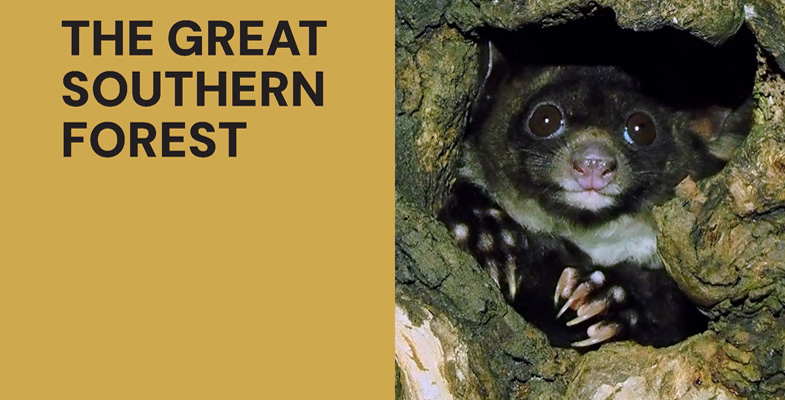
There are many examples of surveys by conservation groups finding wildlife in areas about to be logged. The Glenbog State Forest, southwest of Bermagui is one example where over 100 den tree hollows were found that provide habitat for the endangered Southern Greater Glider. Forestry operations have to leave a 50 m wide radius around these trees untouched. Forestry NSW found only seven trees and had planned to log based on their assessment. As of February 2026 logging seems to have been stopped.
The current uses of logged timber
The current logging operations in southern NSW primarily provide a timber source for the Eden woodchip mill that sends most of its product overseas to manufacture paper. Logs are used to make pallets and there is some production of logs for construction and furniture.
Protection to be provided by the park
The proposal brings together 55 state forests, 24 flora reserves and 98 existing national parks and reserves creating a continuous ecological corridor up to 100 km wide that would be one of the most significant forest reserves in Australia.
The forest reserves would protect:
- more than 10,000 hectares of threatened ecological communities
- habitat for 61 threatened animal species
- 12 endemic plant species found nowhere else
- four critically endangered flora species
- key habitat for the Southern Greater Glider, Yellow‑bellied Glider, Swift Parrot, Spotted‑tailed Quoll and Southern Brown Bandicoot
The park expansion would improve the ecological objectives for forest reserves, known as CAR (comprehensive, adequate and representative) by improving ecosystem representation, protecting underrepresented plant community types, strengthen wildlife corridors and increase resilience to climate change.
Economic benefits
The main argument against closing down native forest logging is the loss of jobs but the report argues that more jobs and revenue will be created in the hospitality, tourism and recreation industries.
National parks attract 65 million visits each year according to the NSW government’s most recent survey with 37 million visits outside Greater Sydney. This same study showed that these parks already contribute $19 billion to regional economies instead of being a drain on state resources.
Steps required
Achieving this proposal will require a coordinated, multi-stage effort:
- build community awareness and support
- work with traditional owners
- engage councils, businesses and local communities
- present scientific evidence of environmental and economic benefits to decision‑makers
- advocate to MPs and ministers
- develop detailed policy proposals
History of the ‘forest wars’
The forests of southern NSW have been a source of conflict since the 1960s. Several local conservation groups have been working to prevent the destruction of these forests. This has involved tree sit-ins, many arrests and court action.
The ‘forest wars’ were triggered by the NSW government decision to support a woodchip mill at Twofold Bay near Eden that started operating in 1969. At the time there were large areas of Crown land (state forests) with dense old growth native forests inland from the far south coast of NSW. At the time, a scientific committee appointed by the government recommended the area of around 100,000 hectares be protected as a national park. However, the Japanese company Harris-Daishowa was controversially given approval to log the area for woodchips. Logging to supply the mill occurred for 25 years until the campaigners were successful is persuading the government to create several national parks in 1994. Eventually in 1997 these were amalgamated with other parks to create the South East Forests National Park with an area of 115,000 ha.
Another large national park, the Murramarang, has been expanded over several years with a strong involvement of campaigners who were successful in buying some private lands around Durras Lake and obtained agreements to add some state forests to the national park. There is now protection for a broad area of coastal forests from urban development and the creation of the Murramarang section of the Great South Coast Walk of 76 km from Ulladulla to Batemans Bay. The Great South Coast Walk long distance walk covers in total 660 km from Royal National Park to Mallacoota. It is not totally continuous – a few waterways get in the way.
References
A Chipmill and the Beginning of the Forest Wars
John Blay (2020) Wild Nature, Newsouth Publishing